
Space 4 Art is proud to continue its dynamic series of cutting-edge exhibitions, public programs, and community-engaged events throughout 2026— an initiative that will at once spotlight and strengthen the city’s vibrant, experimental community.
UPDATED Thursday, July 16, 2026: We're honored that KPBS included PHOSPHENE among its "Top 10 arts events in San Diego this weekend." Read their preview here.
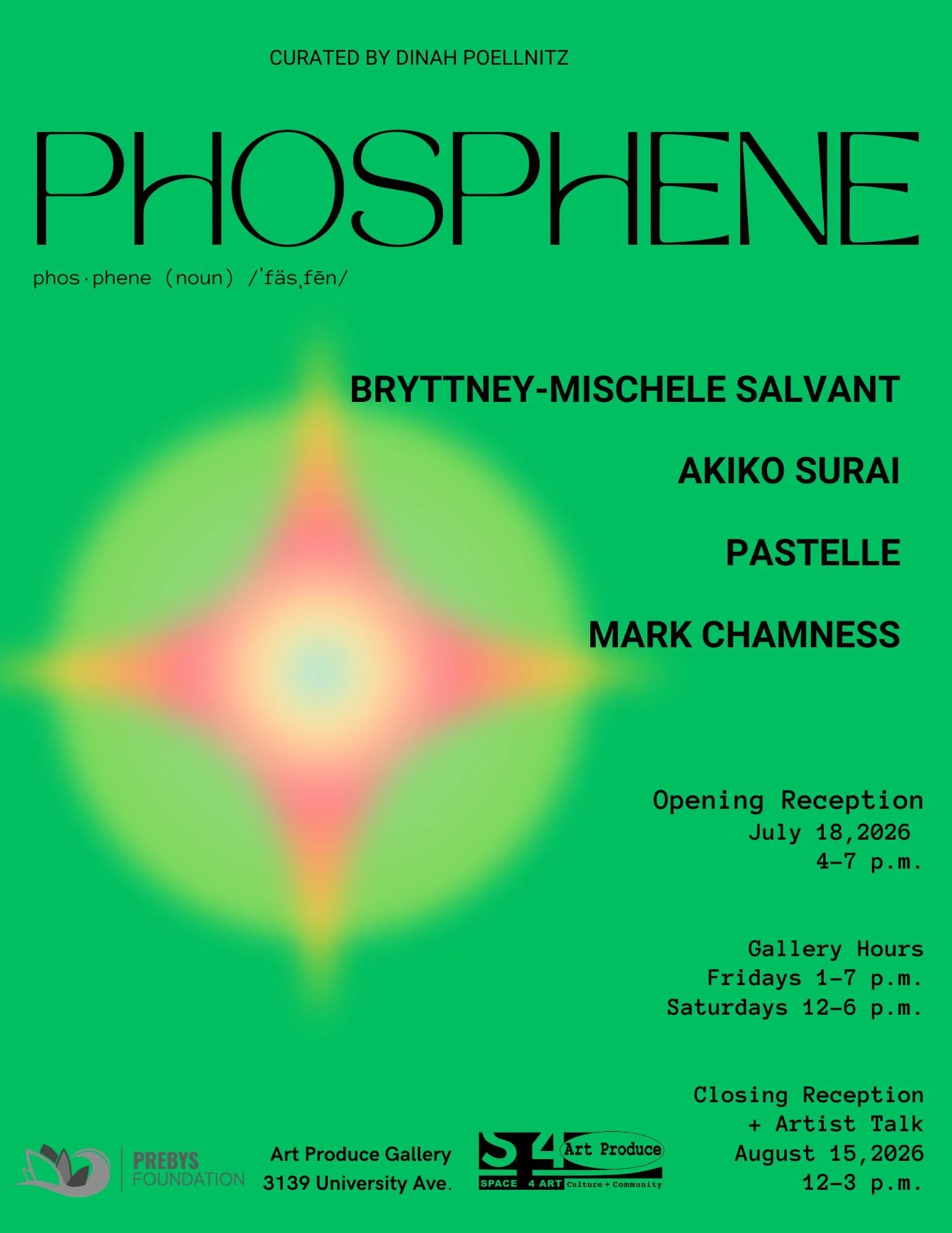
Join us for the opening reception of PHOSPHENE, a group exhibition curated by Dinah Poellnitz that explores the instinctive moments behind artistic creation.
Meet the artists and experience works by Bryttney-Mischele Salvant, Mark Chamness, Pastelle, and Akiko Surai— four artists whose practices reveal the power of intuition, transformation, and personal expression across painting, fiber, illustration, embroidery, and found materials.
Curatorial Statement:
PHOSPHENE
phos·phene (noun)
/ˈfäsˌfēn/
The sensation of light— color, pattern, shimmer —produced by the eye itself, without any external source of illumination. Seen behind closed eyelids. Felt in the dark. Proof that the body makes its own light.
This exhibition begins with that premise and with a word most people have never spoken aloud. A phosphene is the light you see when no light exists: the shimmer behind closed eyes, the color that blooms in the dark, the glow of pure inner vision. It is proof that the body makes its own light.
Phosphene began with a studio visit.
As part of a curatorial residency with Space 4 Art, I was invited to select from their residents as well as other San Diego artists. I chose Bryttney-Mischele Salvant, and those conversations in her studio became the seed of everything you see here. Watching her work, talking through what she was reaching for, I kept returning to one question: What happens when an artist trusts what they feel before they trust what they know? That question led me to Mark Chamness, Akiko Surai, and Pastelle, artists who, each in their own way, have spent their careers negotiating the same tension between instinct and craft, between the organic and the trained.
These artists are not working the same way. But they are all listening for the same thing, phosphene.
Bryttney-Mischele Salvant paints the way she feels, and that is her gift. She came to painting not through institutions but through life, and what she has never lost is the raw, unguarded impulse that formal training so often teaches artists to distrust. In a recent painting, two men shake hands over a chess game, and something extraordinary happens in that gesture: Light and color transfer between their hands like electricity, like memory, like an agreement being made. The hand is not perfectly rendered. The expression is perfect. That is the difference this show is about.
Mark Chamness comes from painting, but has found his truest expression in fiber. He collects discarded plastic bags pulled from beaches and bushes, strips them thin, treats them like yarn, and tufts them into needlepoint. Formally trained, he has deliberately moved toward the handmade, the slow, the found. Color for Chamness is geographic and spatial, always searching for the third space, the in-between, the place where hue becomes territory.
Pastelle works with the confidence of someone who has already decided. Her illustrations are not searching, they are declarations. Color, for her, is not chosen so much as claimed, each shade an extension of a self that has been fully internalized and is now, unapologetically, turned outward. There is a readiness in her work that is rare, a willingness to be seen, to let the image carry everything without apology. Her work lives between a disco ball and a liberated self-awareness— fantastical and radiant, sensual and proud. It is the softest kind of power. In the language of this exhibition, Pastelle's phosphene is the one that fills the whole room.
Akiko Surai's Untitled (mass 03) grows the way living things grow, slowly, deliberately, without permission. Working in embroidery and beading on found stone, she lets fiber creep like lichen across concrete, the material body learning the surface, eventually absorbing it. Inspired by the radical imagination of Black revolutionaries and the cross-pollination of craft traditions across the African diaspora, her work is not decorative. It is architectural. It encodes knowledge. It dreams of new worlds. The inner light in Akiko's practice lives inside the archive, in the craft traditions, the survival instincts, the creative inheritance carried forward through Black revolutionary thought. That light is not a metaphor. It is how we have always built. It is how we continue.
There is a moment every artist knows and rarely names. It arrives somewhere between the first mark and the last, when the mind finally stops negotiating with the hand. When the question of whether it is right dissolves into the certainty that it is real. Scientists call it flow. Poets call it presence. In neuroscience, it lives in the same region of the brain as memory and emotion, the place where what we have felt becomes what we make. These artists did not plan their way to that moment. They surrendered to it. And in that surrender, something was made that could not have been made any other way.
A phosphene cannot be forced. It has to be allowed.
Close your eyes. Notice what's there. That is where this work lives.
Presented by: Space 4 Art in partnership with Art Produce
Supported by: The Prebys Foundation Arts Ecosystem Grant